
The Management Centre
yvette@managementcentre.co.uk
yvette@managementcentre.co.uk


There are days when work can feel out of control, especially in charities and non-profits where tasks rarely arrive in a neat queue. A funder report is due, a colleague needs an answer and your manager has just asked for “a quick chat”. Then there are the harder moments, like giving feedback or breaking news about a change.
Each one brings a choice: do I act on this now, talk it through, or let it wait? Making those choices can take a surprising amount of energy. Sometimes we spend it on things we can’t change and miss options that were open to us all along.
Knowing when to act, when to influence and when to let go is a skill you can build. When you’re clear about which choices are yours, you can put your energy where it makes a difference and stop carrying what isn’t yours to carry.
The Circles of Control model can help. In this blog, “control” simply means the choices that are yours to make. It isn’t about being in charge, or about how in control you feel. People experience this differently. Some of us equate feeling in control with satisfaction, and some of us don’t. Neither is wrong.
This blog will:
The Circles of Control model builds on ideas popularised by Stephen Covey in his best-selling book The 7 Habits of Highly Effective People. It’s a simple way to sort any situation into three areas, so you can see where your choices lie.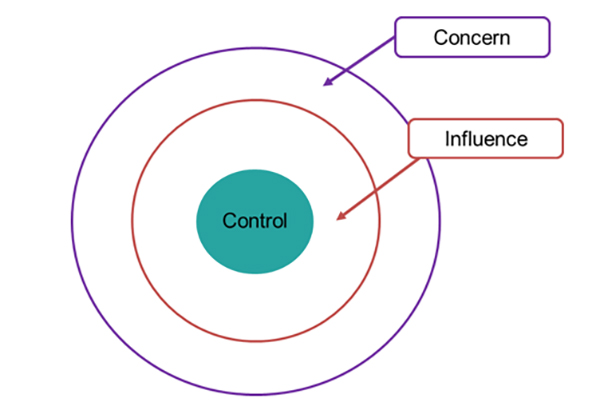
At the centre are the things that are yours to decide. These are usually about your own actions: what you say, what you do and how you respond. For example, you can choose how you prepare for a meeting with a funder, which questions you ask and how you follow up afterwards.
Next are the things you can affect but not decide. This often involves talking to others, sharing information or making a case. For example, you can’t decide whether your trustees approve a new project, but you can shape the proposal they see and offer to answer their questions.
On the outside are the things you care about but can’t change. These are often wider factors, such as the economy, government policy or decisions made elsewhere in your organisation. For example, a funder may change its priorities, and there may be nothing you can do to reverse that.
It can help to find ways to let these go, so they take up less of your energy. Letting go doesn’t mean you stop caring. It means putting your energy where it can make a difference.
Here are some situations at work where the Circles of Control can be helpful:
Many managers find it hard to delegate, especially to someone who is new to a task. Part of that is about letting go: once a piece of work is in someone else’s hands, the result is no longer only yours.
Letting go can bring real benefits. The person you delegate to builds new skills and confidence. You free up time for the work only you can do. And over time, your organisation is better placed to deliver its mission, because knowledge and skills are shared across the team.
You also keep more influence than you might think. You can choose how you delegate: how much support to offer, how often to check in and what standards to agree at the start. You can also take action to make sure the handover is well managed and well received. The right approach depends on the person’s experience and how much risk is involved. This blog shares a simple model to help you understand what you’re asking when you delegate and where the responsibility and accountability ultimately lies: Management Essentials: how to delegate effectively
Organisational change can be one of the hardest things to go through at work. Funding cuts, restructures, resignations, new leadership and new ways of working can all bring uncertainty. This is especially true if it’s part of your role to share updates with your team.

Most of us don’t get to make the big organisational decisions. But there’s often more within our influence than it first seems. People will respond to change in different ways. You can’t decide how they feel, but you can plan how you’ll support them.
If you manage a team, it can help to be open about what is and isn’t within your control or influence. You can reassure people that you’ll do what you can to support them through the transition. That might mean sharing information as soon as you’re able, being open to questions and being honest when you don’t have an answer yet. This helps to manage expectations and build trust.
From time to time, things don’t go the way we hoped. You might not get a job you interviewed for, miss out on a promotion or have a project idea turned down.
You can’t change the decision. But you do have some choice about what happens next. Two questions can help: What choices do I have now? What would I do differently next time?
It’s OK to feel disappointed, frustrated or sad. These are natural responses, and there’s no need to rush past them. When you’re ready, you still have choices about what happens next.
Before you respond to a setback, it can help to take a moment to step away. Give yourself some space and allow the feelings to exist without shame or judgement. They’re just feelings, they come and they go and you don’t need to act on every one of them.
The Circles of Control can then help you decide where to put your energy next.
A healthy feedback culture benefits everyone. People get the information they need to grow. Managers can address issues early, before they become bigger problems. And organisations benefit from teams who learn and improve together, which supports the mission.
You can’t decide what someone does after a difficult conversation. But you do have some influence over how they come away feeling about themselves.

It helps to base your feedback on what you’ve observed, rather than on assumptions. This keeps it factual and based on specific actions that took place, along with their impact. Guessing at what someone’s intentions were is not helpful, even if you guess right! It feeds a culture of second guessing and undermining, which can be really demotivating.
Feedback should never be personal. The aim isn’t to make someone feel bad, but to help them learn. This builds psychological safety: a team where people feel able to speak up, ask questions and make mistakes without fear. Watch this video to find out more about the Three Key Principles of Giving Feedback and how to use them effectively.
Having a difficult conversation for the first time might feel daunting. But it may be worth it if it could help someone improve their performance, give you access to a tool or support you’ve been asking for, or make your standards clear.
You can’t predict exactly how someone will react. But you can think ahead about how you’d respond to different reactions, so you feel more prepared. This blog from the =mc Learning Insights Library looks at some common reactions to a difficult conversation and what you can do to prepare yourself: Help! I need to have a difficult conversation and I’m worried about a bad reaction.
In all of these situations, even the ones that feel most out of your hands, you always have some choice about your own actions and behaviours.
Work brings curveballs, disagreements, big changes and challenging times. Your choices may be limited, but it’s worth taking stock of the ones you do have. It can help to remind yourself what you’re choosing to do in a situation, and why.
Next time you’re facing a tricky situation, try sketching out the three circles. What’s yours to act on? What can you influence? What might it help to let go?
You may find you have more choices than you thought, or that there’s something you can stop carrying.covey
If you’d like to help your team build these skills, our Assertive Conversations programme can be delivered in-house and shaped around your organisation. Call us on +44(0)74 3690 3103 or contact us online to talk about what would work for your team.